







What Your Golf Handicap Actually Measures
Every golfer I meet tells me their golf handicap inside the first two minutes. I’m a 12. I’m about an 8. I play to around 15 on a good day. I do ask for it within our Player Profile. But they volunteer this information very quickly.
Here’s the problem. I can’t fully evaluate a golfer I’m coaching based solely on golf handicap. It’s highly likely your golf handicap is a fictitious number.
Not because you’re lying to me. Because of how the number gets built, what gets fed into it, and what quietly never makes it in to your golf handicap. I’ve coached golfers of all skill levels for over 30 years. I can count on one hand the clients who can explain what their Golf Handicap Index actually measures. And can count even fewer golfers who actually play to their handicap.
After my September 2026 blog and video about playing the correct yardage, many golfers commented in the video that they play from the correct tees because their handicap and handicap table hang on the locker room bulletin board at their club. There were a lot of misguided comments in that direction. Sometimes being a golf coach means forgetting the technical side of the game and coaching my clients to understand the nuances and math within it, like explaining your handicap and why you think you’re a worse golfer than you actually are. The misconceived comments, along with the woe is me stories I hear from higher handicap clients about score versus golf handicap, score versus performance, and your score related to how you perceive yourself as a golfer, has led me to reschedule my blog posts for the rest of 2026 so I can help golfers understand who they really are, based on their scores, skills, and potential.
So let’s have the argument. Your golf handicap probably isn’t real. And that’s costing you. In the member-guest. At the handicapped tournaments you play. And even in your weekly game with your golfing friends. It also costs you in how you pick a target. And in whether you ever get an honest look at your own game.
I’ll tell you what your golf handicap number is. Then I’ll tell you the four ways golfers break their golf handicaps. Most of you are guilty of at least two of those ways. Intentional or not.
Your Golf Handicap Isn’t Your Average. It Never Was.
Let’s start with this premise all higher handicaps believe but always get wrong.
The USGA is direct and simple about your golf handicap index. Your Handicap Index reflects your demonstrated playing ability, and it’s calculated by averaging your eight best score differentials from your most recent 20 rounds.
Read that again. Eight best Score Differentials. Out of 20. Most golfers have no clue what a score differential is.
But before we define that term, let’s deal with the hard facts. Twelve of your last 20 rounds don’t count. Those 12 scores don’t count toward the calculation of your golf handicap, at all! The system throws them out. On purpose. Your handicap was never built to describe your typical Saturday. It was built to describe what you’re capable of when things go reasonably well.
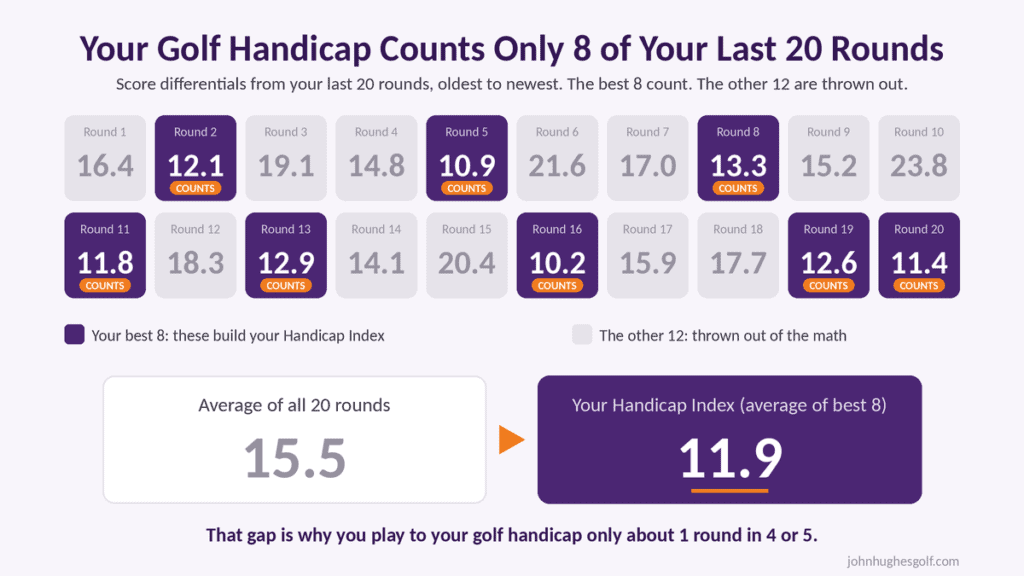
So when you say you’re a 12, you’re not saying you shoot 84. You’re saying that on your better days, over your last 20 times out, you’ve demonstrated you can play to roughly 12 over the rating of the tees you’re on.
That’s a very different claim. And it’s a much higher bar than most golfers realize they’re setting for themselves.
The other half of the math is the Score Differential itself. Each round gets converted before it ever counts. The system takes your adjusted gross score, subtracts the Course Rating, accounting for how the course played that day, and then scales the result against the Slope Rating of the tees you played. That’s why a 92 from the back tees at a brutal track can produce a better differential than an 88 from the forward tees at your home course.
You’re not posting scores. You’re posting performances, graded against difficulty. Those are two different things, and the gap between them is where most of the confusion lives.
You’re Supposed to Miss It Four Rounds Out of Five
This is the part that changes how you feel walking off 18.
Because the index is built from your best eight, you should expect to post rounds worse than your golf handicap, most of the time. Golfers play to their handicap roughly 20 to 25 percent of the time, according to USGA figures. One round in four or five. The rest of the time, you should expect your scores to be a few shots higher.
If you’re a 12 and you’re playing a course where your Course Handicap comes out to 13, par 72, your target score is 85. You’ll hit 85 or better about once a month if you play weekly. Your normal round sits a few shots higher, somewhere in the high 80s.
And you view that score as a failure. It’s not! That’s the golf handicap system working exactly as designed.
I watch clients beat themselves up over this every week. A golfer shoots 88 off a 12 handicap and walks in the clubhouse convinced he or she is regressing. Not True! You just played a completely ordinary round for a 12-handicapper, and nobody ever told you what ordinary should look like.
There’s a second layer too. Low handicaps hit their number more often than high handicaps do, because better players are more consistent. The spread between your good rounds and your bad rounds narrows as you improve. If you’re a 22 and you almost never shoot scores to that number, that is to be expected. And if you’re expecting a different and lower score, you’re fooling yourself. That’s variance, and it’s exactly what a 22 handicap is.
Please know your realistic target score before you tee off. It is calculated from the Course Handicap plus par. Write it down on the scorecard before the round if you have to. Doing so, you may find yourself treating what you thought was a disastrous round as a normal round of golf.
IMAGE 3: Target score on the card (delete this box before publishing)

Break No. 1: You’re Posting Scores You Didn’t Shoot
Get ready to get really uncomfortable with me, and more so with yourself. Because this one subject, within the general subject of golf handicap, hits hardest at the heart of the matter.
The gimme inside three feet. The breakfast ball on the first tee because you weren’t warm. The nudge out of a divot because it wasn’t your fault. The second putt you picked up because the group behind you was waiting. The ball you dropped in the fairway instead of going back to the tee.
Every one of those is a stroke that didn’t make it onto the card. And then you posted the score anyway.
Do that four or five times a round and you’ve shaved three or four strokes off a number you’re about to feed into a system that only keeps your eight best. The system doesn’t know. It can’t know. It takes what you give it.
When higher handicaps come to our Orlando Golf Schools and we take these golfers to the course for on-course coaching, we see the real golfer. Not just the golfer and the skills you bring to the course. But how you handle your adversities. We see it all the time. Rolling the ball in the fairway, not counting penalties, exaggerating “inside the leather” with a long putter, and a host of other “gimmes” that add up to you posting a lower score than you actually shot. Just to satisfy your ego, that day. If you’re doing these things and posting scores that make you look like a mid-handicapper, but you’re playing to a higher handicap, no wonder you’re pissed off all the time with your scores!
Now run that out over 20 rounds or more. Your golf handicap index will always be two to five strokes below who you actually are as a golfer. And you spend the next season wondering why you never, ever play to your golf handicap.
You’re not playing badly. You’re chasing a number you invented.
Let’s be real here. I’m not asking you to grind out every three-footer in a casual round with your buddies. I’m asking you to be honest with yourself about what happens next. If you picked it up, you don’t know you made it. Count the stroke. If you took a mulligan, that round isn’t a score you can post. Enjoy the round and leave the phone in your pocket.
Break No. 2: The Rounds That Never Make It Into the App
You shot 79 in June. It went up before you got to the parking lot.
You shot 97 in July. Funny how that one slipped your mind.
Selective posting is the most common form of ‘vanity handicap’ fraud, and most people guilty of it are genuinely offended when they hear “sandbagging” described as a crime. I’m sure it doesn’t feel like you’re cheating. It feels more like editing. That round was an anomaly. I was sick. My back was out. The weather sucked. We were playing a scramble on the back nine anyway.
The rule is simple. Post every acceptable score. Every Score! Good day, bad day, embarrassing day.
And before you tell me it won’t matter because the system only counts your best eight, think it through. Those 12 discarded rounds still have a job. They’re the denominator. They’re what keeps the best eight in context and the record honest over time. Leave out all your bad days and your 20-round window fills up with nothing but highlights.
That’s not a handicap. That’s a highlight reel. And your best shots on a highlight reel are dwarfed by the amount of money you’re forking over to your golfing buddies each weekend.
The tell is easy to spot. Look at your scoring record right now. If your posted rounds are bunched tight with almost no ugly ones in there, you’re not posting everything. Real golf has ugly rounds in it. Mine certainly does.
Break No. 3: You’ve Never Applied Net Double Bogey
This one steers you in a completely different direction. Yet, almost nobody knows about it.
If you have an established Golf Handicap Index, the maximum you can post on any hole is net double bogey. That’s double bogey plus whatever handicap strokes you get on that hole. If you’re getting a stroke on a par 4, the most you can post there is a 7. Not the 9 you actually made.
If you’re still establishing your golf handicap index and have fewer than 20 scores in, the limit is different. Par plus 5 on any hole.
Think about the golfer who makes a snowman on the hardest par 4, posts the raw 8, and never adjusts. That golfer is inflating their own golf handicap index with one blow-up hole. Over 20 rounds, a couple of untouched disasters a round will push their number a full stroke or more above where it belongs.
That’s the honest golfer getting punished for being honest. You’re doing everything right except the one adjustment nobody taught you.
Most apps handle this automatically when you enter hole by hole. Most golfers enter a total score instead, because it’s faster. If you post totals, you are almost certainly posting an unadjusted number. Start entering by hole for the next 20 rounds and watch what happens.
It’s the single easiest fix in this entire post.
Break No. 4: The Sandbagger Conversation Nobody Wants to Have
Every club has one. The guy who shows up at the member-guest playing six shots better than his number, collects the crystal, and goes back to being a 14 by Tuesday.
Let’s not pretend this doesn’t happen, because it does. But I’ll tell you what I actually see after 30+ years around golf clubs. Deliberate sandbagging is rarer than the complaining suggests. What’s far more common is the guy whose number is wrong for all the reasons above, and who happens to catch his one good round in four on the weekend that matters.
By the way, the golf handicap system does have some teeth to prevent this. The USGA builds safeguards into the calculation. Post a score 7.0 strokes or better than your index at the time you played, and an exceptional score reduction pulls your number down right away. Soft and hard caps also stop your index from ballooning more than it should when you’re playing badly.
The math is watching, even when nobody at the club is.
The real point of these autocorrections to protect you from sandbaggers is this. Both directions of posting scores, inflated and high or artificially low, hurt you. And the one that gets all the attention is the less damaging one. An index that’s too high costs somebody else a trophy. An index that’s too low costs you every single week. You never play to your number. You feel like you’re going backward. Leading you to believe you need swing changes you don’t need.
Worry less about the sandbagger two groups ahead of you. Worry about whether your own number describes a golfer who exists.
How to Build a Real Number in Your Next 20 Rounds
You don’t need to burn your record down and start over. You need 20 honest rounds, and the window takes care of itself.
Here’s exactly what I ask my clients to do.
- Hole out everything. For 20 rounds, no gimmes. Tap it in. You’ll be amazed how many three-footers you’ve been giving yourself that you don’t actually make.
- Play the ball as it lies. No mulligans, no rolling it in the fairway, no breakfast ball. If your group plays a different way, that’s fine. That round just isn’t counted toward creating your golf handicap.
- Enter hole by hole, not totals. This is what triggers the net double bogey adjustment automatically, and it’s the fastest correction available to you.
- Post every acceptable round. The 97 goes in the same as the 79. Same day you play it.
- Write your target score on the card. Course Handicap plus par, before you tee off. Then judge the round against that, not against the best score you ever shot.
Twenty rounds in, your index will be different. For most golfers I work with, it moves up a stroke or two, and that’s the whole point. It’s finally describing the golfer who showed up.
And once the number is real, something useful happens. You can measure against it.
What an Honest Golf Handicap Actually Buys You
Here is why I care about golf handicap and why I shuffled my blog post schedule to address it, once and for all. And it has nothing to do with you playing in your member-guest.
An honest index is a baseline. Without one, you have no way to tell whether anything you’re working on, whether with one of my staff coaches or me, is making a difference. You change your grip, you buy a new wedge, you take three lessons, and you have no reliable instrument to measure any of it against. You’re guessing, and your memory of your own golf is generous. Every golfer’s memory is. Your handicap is the baseline for your scoring. Later this winter, I’ll show you how to build the same kind of baseline for your swing in the simulator.
With an honest index, three things get easier.
- You can tell improvement from noise. A real index that drops 1.5 strokes over a season is progress you can trust. A fake one that bounces around tells you nothing.
- You can pick the right yardages. Refer back to my September 2026 blog on this subject, which shares the same honesty. Your golf handicap index and your driving distance together can tell you which set of tees gives you a scoring chance. Fudge the index and you’ll talk yourself into playing a golf course that doesn’t fit you.
- And you can set a goal you’ll actually reach. If your real number is 16 and you’ve been telling people you’re a 13, breaking 85 feels like failure every week. Start from 16 and breaking 85 is a genuine, reachable target with a plan behind it.
Ask any of the best golf instructors in Orlando and they’ll tell you the same thing. I’d rather coach an honest 16 than a fictional 13. The honest 16 and I know where we stand on day one. The fictional 13 spends six weeks being disappointed with the entire improvement process before we get to the truth.
Conclusion: Your Golf Handicap Should Describe The Real Golfer
On the record, I’m not calling any golfer a cheat. I’m telling golfers with mid-to-high handicaps that the number you quote at the first tee was probably built on gimmes, selective posting, unadjusted blow-up holes, and a misunderstanding of what the thing measures in the first place.
Your golf handicap isn’t your average. It’s your eight best score differentials out of 20. In four out of five rounds, you’ll post a higher score than your golf handicap. The entire process of establishing a golf handicap is only as good as the real scores you feed the system.
Twenty honest rounds. That’s the simple and real ask of you. Hole everything out, post everything, enter hole by hole, and judge yourself against Course Handicap plus par instead of against the best round of your life.
Afterward, then come talk to me about where the strokes actually are.
With winter coming, your honest number picks up one more job. It’s your scoreboard for the off-season. Next month, I’ll share my three keys to improving your winter golf. Come spring, use the real golf handicap you’ve established with me as the measuring stick for whether your winter improvement program worked.
Maybe you found this post searching for private golf instructors near me, or you’ve been comparing golf instructors in Orlando. If you want help turning an honest golf handicap number into a lower one, that’s what I do. I’m John Hughes, a PGA Master Professional of Instruction, Golf Magazine Teacher to Watch, one of Golf Digest’s Best Golf Instructors in Florida, and a Golf Tips Magazine Top 25 Instructor, with more than 30 years of coaching behind me. My certified coaching staff and I work with clients year-round at Omni Orlando Resort at ChampionsGate. Book an hourly golf coaching session to start with one piece of your game. Or schedule a series of golf coaching sessions with our Custom Coaching Memberships. If you’d rather spend a couple of days rebuilding your game with on-course coaching, secure your dates now for a winter/spring one-to-one golf school. Either way, bring your real scoring record. Start with an honest golf handicap, and we’ll build from there.