






You used to hit a seven iron 160 yards. Now it is 135 on a good day, and your back lets you know about it the next morning.
That shift is normal, and it is also very fixable. Most of the golf tips for grandparents and players over 60 floating around online focus on accepting less. That is the wrong starting point. You can keep a powerful, repeatable swing well into your seventies and eighties. It just has to be built around the body you have now instead of the one you had at 35.
Why does your golf swing change as you get older?
Your swing changes with age mainly because your hips, upper back, and shoulders lose rotation, and the swing you built years ago depended on that rotation.
When the turn shortens, the body looks for distance elsewhere. Usually that means the arms start doing the work. The hands get active, the club gets thrown from the top, and the ball starts slicing or hooking in ways it never used to.
Balance shifts too. Many older golfers stop finishing their swing because they feel unsteady in the follow-through. That cuts off speed right where you need it most.
None of this means you need to swing harder. It means you need a motion that fits your current range of motion and gives you more speed for the same effort.
How can seniors improve flexibility for golf?
Seniors can improve flexibility for golf by doing short, consistent mobility work almost every day, focusing mostly on rotation through the upper back and hips.
Ten minutes is enough. What matters is that you do it often. A routine worth starting:
- Seated or standing trunk rotations with a club across your shoulders
- Hip openers, like a gentle lunge with a slow rotation toward the front leg
- Cat and cow stretches to loosen the upper back
- Slow practice swings at half speed, gradually making the turn bigger
- Balance holds on one foot for 20 to 30 seconds per side
Before a round, warm up with movement instead of static stretching. Swing two clubs together slowly. Make a dozen easy swings with a wedge. Hit a few short shots before you ever pull out a driver.
If you have a joint replacement, a back condition, or anything your doctor is watching, check with them before adding new stretches. The goal is more range of motion, never pain.
What swing changes help senior golfers hit it farther?
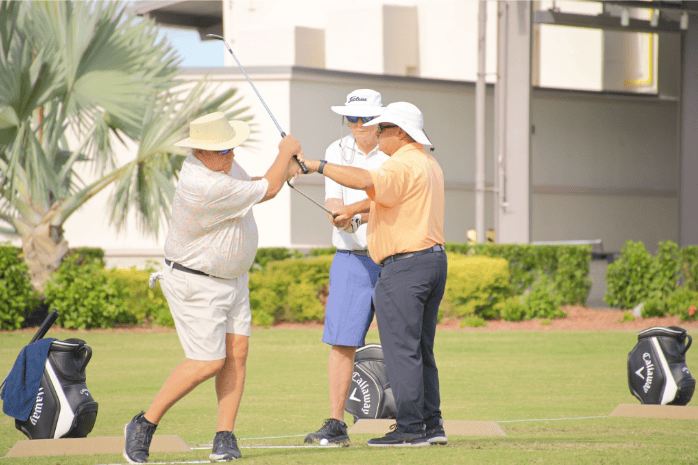
The most helpful swing changes make turning easier, so you can create speed with your body instead of forcing it with your hands.
Flare your feet. Turning both toes out slightly at address frees the hips to rotate, both going back and coming through. It is a small adjustment that many players feel right away.
Let your lead heel come up. Many great players from earlier generations let the front heel lift on the backswing. If your hips are tight, that little lift buys you more turn without straining your lower back.
Shorten the backswing on purpose. A compact, controlled backswing will almost always beat a long one that collapses at the top. Speed comes from the downswing sequence, and a shorter swing is easier to sequence.
Check your grip. A slightly stronger grip, with the hands turned a bit more to the right for a right-handed player, helps square the clubface without needing as much rotation. That one change cures a lot of late-career slices.
And finish the swing. Hold your follow-through until the ball lands. If you cannot hold it, your balance is telling you something worth working on.
Should senior golfers change their equipment?
Most senior golfers benefit from a fitting, since the clubs that fit you at 45 rarely fit you at 70.
Lighter shafts with more flex help you generate clubhead speed with less effort. Higher-lofted fairway woods and hybrids launch far more easily than long irons, and many players do well replacing everything below a six-iron with hybrids. A driver with a little more loft can add carry, even though it sounds backward.
Grips matter more than people think. Slightly larger, softer grips are easier on the hands and can reduce forearm tension. If arthritis is part of the picture, this is one of the cheapest and most noticeable changes you can make.
A professional fitting with Callaway equipment removes the guesswork. Instead of buying what a friend likes, you get loft, shaft, and grip matched to your actual swing speed.
Are Florida golf schools for seniors worth it?
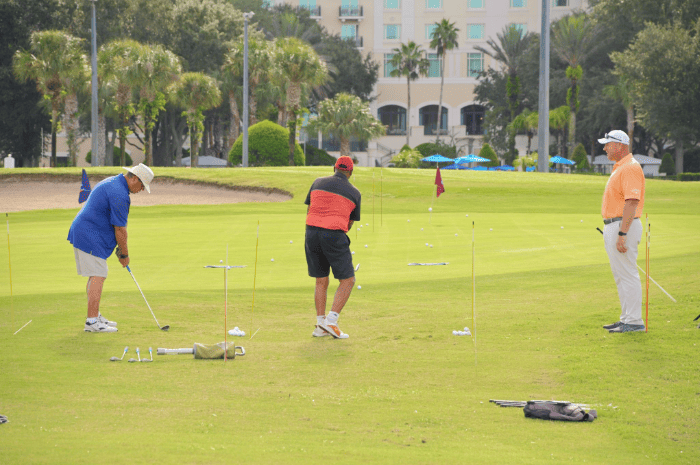
Florida golf schools for seniors are worth it when instruction is built around your body and goals, not a one-size-fits-all swing model.
A good school starts with an evaluation. Where do you lose speed? What does your range of motion actually allow? What does your short game look like under real course conditions? From there, we match the coaching to you.
At John Hughes Golf, we hold full-day and half-day golf schools at Omni Orlando Resort at ChampionsGate. Full-day schools run in a 1-to-1 or 2-to-1 format and can include nine holes of on-course coaching. Every school includes video analysis, take-home learning, and follow-up coaching after you leave, so the changes don’t fade once you are back on your home course.
The timing helps too. From late fall through early spring, central Florida offers comfortable temperatures and dependable sunshine, which makes it an easy place to spend a few focused days working on your game.
Short games deserve special attention for older players. Distance off the tee naturally declines with age, while chipping, pitching, and putting can keep getting better for decades. A school that sends you home with a sharper short game can lower your scores even if your driver stays exactly where it is.
John Hughes is a PGA Master Professional of Instruction in Orlando, a Golf Magazine Teacher to Watch, a Golf Tips Magazine Top 25 Instructor, and a Golf Range Association of America Top 100 Instructor.
Ready to build a swing that works for the body you have today? Contact John Hughes Golf or call 407-852-8547 to talk through lessons or a golf school that fits your schedule.